Manifestation Determination Review: What It Is and What Parents Need to Know
If your child has an IEP and the school is moving to suspend or expel them for more than ten school days, the law requires a meeting called a manifestation determination review, or MDR. The purpose of that meeting is to answer one question: was the behavior connected to your child's disability, or was it caused by the school failing to follow the IEP? If the answer to either part is yes, your child cannot be removed the way the school is proposing, and the team has to respond with support instead of punishment. That protection comes from the Individuals with Disabilities Education Act, and it exists precisely because students with disabilities are suspended and expelled at far higher rates than their peers, often for behavior that is part of the disability itself.
This page walks you through what an MDR is, when it is required, how the meeting actually works, and what to do if you disagree with the result. It is written by a special education advocate who spent years as a classroom teacher specializing in behavior and as a campus 504 coordinator, so this is the view from inside the room, not just the statute.
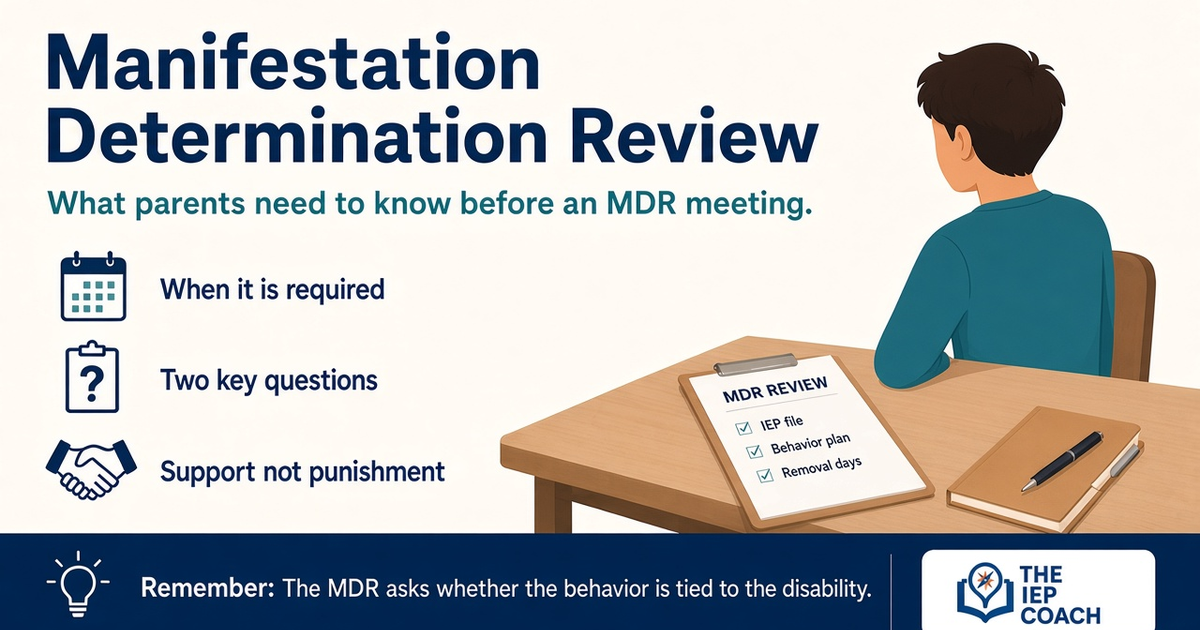
What a manifestation determination review is
An MDR is a meeting of your child's IEP team, including you, that has to happen when a disciplinary removal becomes what the law calls a change of placement. It is not a punishment hearing and it is not optional. The team reviews all relevant information in your child's file, including the IEP, teacher observations, evaluations, and anything you bring, and decides two things.
First, was the conduct in question caused by, or did it have a direct and substantial relationship to, your child's disability? Second, was the conduct the direct result of the school's failure to implement the IEP? If the honest answer to either question is yes, the behavior is a manifestation of the disability. That finding changes everything about what the school is allowed to do next.
Here is why this matters in plain terms. A student with an emotional disability who shuts down and bolts from class, a student with autism who has a meltdown when a routine changes without warning, a student whose behavior intervention plan was written but never actually used by staff: in each of those cases, punishing the child for the behavior misses the point. The behavior is information about an unmet need. The MDR is the law's way of forcing that question before a child loses access to school.
When an MDR is required
The trigger is a disciplinary change of placement, and there are two main ways a removal reaches that line.
The first is a single removal of more than ten consecutive school days. If the school proposes to suspend your child for eleven days, or to expel them, an MDR is required and it must happen within ten school days of the decision to change the placement.
The second is a pattern of shorter removals that adds up. Schools sometimes use repeated short suspensions, three days here, two days there, and treat each one as separate. But when those removals total more than ten school days in a school year and form a pattern, because the behavior is similar, the removals are close together, or they add up to a long stretch out of class, that pattern can itself be a change of placement that requires an MDR. This is one of the most common places parents get quietly shortchanged, because the running total is rarely put in front of them.
A few other points worth knowing. During any removal beyond ten school days in a year, the school still has to provide educational services so your child can keep progressing toward their IEP goals. These protections also reach some students who do not yet have an IEP, if the school had reason to know the child needed special education before the behavior happened. And there are specific situations, involving weapons, illegal drugs, or serious bodily injury, where a school can move a child to an interim setting for up to forty-five school days regardless of the manifestation finding. Even then, the MDR still has to happen, and your other rights still apply.
How the MDR process works
The process moves fast, which is exactly why preparation matters. Here is how it works in three steps.
Step one: get organized before the meeting. Request the paperwork the school is relying on, including the discipline referral, the proposed removal, the current IEP, and any behavior intervention plan. Count the removal days yourself for the whole year so you know whether a pattern already exists. Pull together what you know about your child's disability and how it connects to the behavior. If a behavior plan exists, look at whether it was actually followed. Going in prepared is the difference between a meeting that happens to you and a meeting you help steer.
Step two: make the case at the meeting. The team reviews the records and answers the two questions. Your job is to connect the dots out loud between the disability and the behavior, and to raise implementation. If the IEP called for breaks, a one-on-one aide, a check-in system, or a behavior plan, and those supports were not in place when the incident happened, that goes directly to the second question. You are a full member of this team, and your input is part of the record.
Step three: hold the team to the right follow-through. If the behavior is found to be a manifestation, the team generally must conduct a functional behavioral assessment and write or revise a behavior intervention plan, and your child returns to their placement unless you and the school agree to something different as part of that plan. If the team finds the behavior was not a manifestation, your child can be disciplined like any other student, but the school still owes continued services, and you have the right to challenge the decision.
How an advocate helps, and how it differs from a lawyer
An MDR is a legal process that happens on a school schedule, usually with very little notice, and most parents are walking into it for the first time while the school staff have done it many times. That imbalance is the problem an advocate solves.
As an advocate, I help you read the discipline record before the meeting, count the removal days correctly, and build the connection between your child's disability and the behavior in language the team has to engage with. I help you surface whether the IEP was actually being implemented, because a failure to implement is one of the two ways the law says the behavior is a manifestation. I can attend the meeting with you, in person or virtually, so you are not the only person in the room who knows how this is supposed to go. And I help you plan the next step if the result is wrong, including the functional behavioral assessment, the behavior plan, and your appeal rights.
An advocate is not a lawyer and does not provide legal representation. I do not file lawsuits or represent you in a due process hearing as counsel. What an advocate does is help you understand your rights, prepare, and communicate effectively with the school. If your situation needs a lawyer, for example an expedited due process hearing, I will tell you plainly and help you understand when that line has been crossed.
Virtual and nationwide
Special education discipline runs on the same federal law, IDEA, in every state, so this support is not limited by geography. I work with families across the country, and MDR support in particular is well suited to virtual help because the timeline is short. We can review your child's records over a screen share, prepare together by video, and I can join the MDR meeting remotely. Wherever you are, if the school is moving to remove your child and an MDR is on the table, you do not have to walk in alone.
If your child with an IEP is facing suspension, expulsion, or an MDR meeting, reach out today. The clock on these timelines is short, and early preparation makes a real difference.
Prefer to talk it through first? Call (512) 865-1937.
Frequently asked questions
The IEP Coach provides advocacy and consulting support, not legal representation.