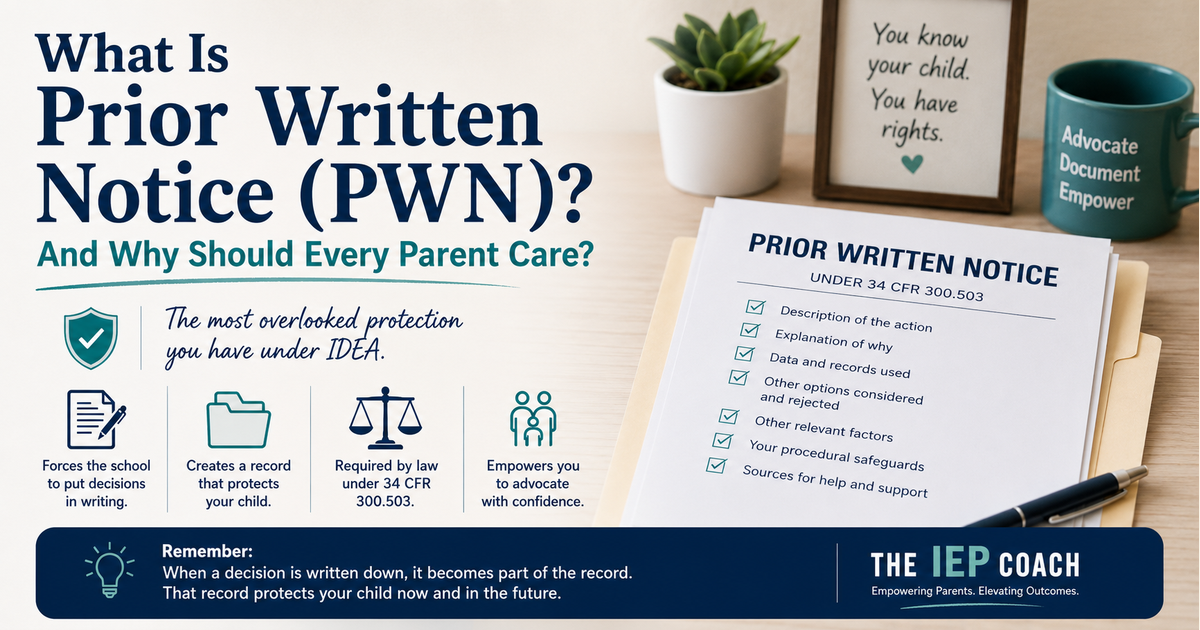
Prior Written Notice, or PWN, is the formal document a school must give you whenever it proposes or refuses to change your child's identification, evaluation, placement, or provision of a free appropriate public education (34 CFR 300.503). Most parents have never heard of it. It may be the single most useful protection you have in the entire special education process.
Here is why:
Prior Written Notice forces the school to put its decisions in writing.
And decisions in writing are much harder to walk back, deny, or quietly forget.
What Prior Written Notice Actually Is
Prior Written Notice is a formal document the school must give you when it proposes or refuses to take an action about your child's identification, evaluation, placement, or provision of a free appropriate public education. It is required by federal law under IDEA, at 34 CFR 300.503.
That includes decisions to:
- Start, change, or refuse an evaluation
- Change your child's eligibility for services
- Change goals, services, minutes, or placement
- Refuse something you have requested
If the school says yes or no to something important, Prior Written Notice is how that answer becomes official and part of the record.
What the Law Requires It to Include
IDEA does not just require a notice. It requires a complete one. Under 34 CFR 300.503(b), a Prior Written Notice must include:
- A description of the action the school proposes or refuses
- An explanation of why the school is proposing or refusing it
- A description of each evaluation, record, or report the school used to decide
- A description of other options the team considered and why they were rejected
- A description of any other relevant factors
- A statement that you have protections under the procedural safeguards
- Sources you can contact for help understanding your rights
The notice must also be written in language understandable to the general public and provided in your native language when possible (34 CFR 300.503(c)).
When the School Must Give It to You
The school owes you Prior Written Notice a reasonable time before it makes a change, and also when it refuses your request. This is the part parents miss. If you ask for an evaluation and the school says no, a verbal no in a meeting is not a legally complete answer. The district must give you Prior Written Notice explaining the refusal in writing.
Many parents accept a verbal no and walk away discouraged. You do not have to.
Why It Matters So Much
When a decision is spoken in a meeting, it can be softened, denied, or forgotten later. Memories differ. Staff change. When a decision is written in a Prior Written Notice, it becomes part of the permanent record. That record protects your child. If you ever need to file a state complaint or challenge a decision, that paper trail becomes your strongest evidence.
Reasonable decisions hold up in writing. Weak ones often do not, which is exactly why asking for the notice can change the outcome.
A Common Myth
Myth: "If the school says no, that is the final answer."
Parents believe this because a no delivered confidently in a meeting sounds final. It is not. Under IDEA, when a school refuses to evaluate, change services, or change placement, it must give you Prior Written Notice explaining the refusal and the data behind it (34 CFR 300.503). A verbal no is not a legally complete response.
There is a second, quieter myth worth naming: "Prior Written Notice is just routine paperwork I can file away." In fact, it is one of the most valuable documents you will ever receive. It records exactly what the school decided, when, and why, in its own words. That record is what protects your child if you ever need to challenge a decision, request mediation, or file a state complaint.
The reality is that no is the beginning of a process, not the end of one. When you ask the school to put its reasoning in writing, weak decisions often do not survive the request, and strong ones at least become clear enough to respond to.
Tips for Parents
- After any meeting or phone call where a decision was made, send a short email summarizing what was said. It creates your own record.
- When you make a request, put it in writing and date it. Verbal requests are easy to lose.
- If you are told no, ask for Prior Written Notice by name. Do not let the conversation end with an unexplained refusal.
- Keep every PWN in one folder. Over time it becomes a clear history of every decision made about your child.
What You Can Say
"I understand you are declining my request. I am asking for Prior Written Notice that explains the decision and the data behind it."
What if You Never Receive One
Sometimes the bigger problem is not a weak notice, but no notice at all. A school changes your child's services, minutes, or placement, and you find out later, or never in writing. That is not allowed. Prior Written Notice must come before the change takes effect, in language you can understand (34 CFR 300.503).
If a change happened and you never received notice, ask for it directly: "You changed my child's services. I am requesting the Prior Written Notice that should have explained this decision." Putting that request in writing does two things. It creates a record that the change happened without proper notice, and it requires the school to justify a decision it may have made quietly. Silence is not a substitute for notice.
If services in the IEP are being changed quietly, or simply not delivered, that is a separate problem worth understanding. See what to do when the school is not following the IEP.
A Real-World Example
James asked his daughter Ava's school to evaluate her for a learning disability. In the meeting, the team told him they did not think it was necessary and suggested waiting another semester. James almost accepted it.
Instead, he said one sentence: "If the district is declining to evaluate, I am requesting Prior Written Notice explaining the refusal and the data behind it."
Two things happened. First, the tone shifted, because now the school had to justify its position on paper. Second, when the team actually looked at what data supported waiting, there was not much. Within a week, the school reconsidered and agreed to evaluate Ava. James did not argue harder or raise his voice. He simply asked the school to write it down.
The "let's wait and see" answer often comes wrapped in intervention language. If you are hearing it, read whether RTI or MTSS can delay a special education evaluation.
The Bottom Line
Prior Written Notice turns vague conversations into accountable decisions. You do not have to argue harder. You have to ask the school to write it down.
Final Thought
Schools make dozens of decisions about your child every year. Prior Written Notice makes sure the important ones are explained, recorded, and defensible.
If a school has refused a request and you are not sure what to do next, The IEP Coach can help you request Prior Written Notice and plan your next step.
Frequently Asked Questions
What is Prior Written Notice?
It is a formal document a school must give you when it proposes or refuses to change your child's identification, evaluation, placement, or services (34 CFR 300.503).
When must a school give Prior Written Notice?
A reasonable time before it makes a change, and whenever it refuses a request you have made.
What must a Prior Written Notice include?
The action proposed or refused, the reasons, the data used to decide, other options the team considered, and a statement of your rights under IDEA.
What if the school never gave me notice?
Ask for it in writing. Notice is required before a change, and requesting it creates a record and requires the school to justify the decision.